Monday, September 14, 2009

“We have not come here to take prisoners…”

handstandcitybychrisoisgayo26


“…but to surrender ever more deeply to freedom and joy. “

“Run my dear

from anything

that may not strengthen

your budding wings.” 

“For we have not come here to take prisoners

Or to confine our wondrous spirits

But to experience ever and ever more deeply

Our divine courage, freedom, and Light.”

…The Sufi poet Hafiz

Sunday, September 13, 2009

Lizzie Miller: “This body is her dulcimer.”

By now you’ve likely seen this photo. 

It’s the model Lizzie Miller, published in the September issue of Glamour Magazine.  According to press sources, it’s causing a “stir” because of one thing:  Lizzie’s tummy.  

I saw this first on The Sartorialist, where 500+ readers commented. Up to now, I’ve never seen more than about 175 comments, tops, on any Sart post.  

Several thoughts came to my mind after reading the press.     

Number one.  Twenty-year-old Lizzie works as a “plus-size” model.  At five-foot-eleven (1.80m), she wears a size US 12 or 14 (British 16 or 18, or European 46 or 48).  

Lizzie states that

“It’s sad. In the industry anything over size six is considered a plus-size. Pretty much every picture in a magazine or ad is airbrushed... I don’t think the public understands how much smoke and mirrors are involved in making women look like that…I’m not trying to promote obesity, and I’m not obese, but I’m also not stick thin.”

So why are women her size called “plus-sized?” 

Number two.  Public comments about Lizzie’s photo have been overwhelmingly positive—people shouting, “Finally, someone who looks like a real woman in major fashion magazine.”

But other folks complain that such imagery encourages obesity.     

So on the one hand we have photos everywhere of women who appear anorexic.  Now we have Lizzie, who appears real but is labelled, basically, a fatty. 

I acknowledge that Americans, including myself, are wont to overindulge, and our average weight has crept up dangerously in the past thirty or forty years. 

Still, is there gray area in the media between “thin” and “obese?” 

Number three.  For the title of this post, I paraphrased an ancient poem by Kabir, a 15th-century Indian poet.  The original reads:

“Listen, friend.  This body is his dulcimer.  He draws the strings tight, and out of it comes the music of the inner universe.”   

Can a body’s strings be drawn tight, even if one’s tummy is not? 

Look at Lizzie’s smile.  Do you detect her inner universe?   

sallymandy

Saturday, September 12, 2009

La Main de Madame Hugo and Other Photos of Women in History

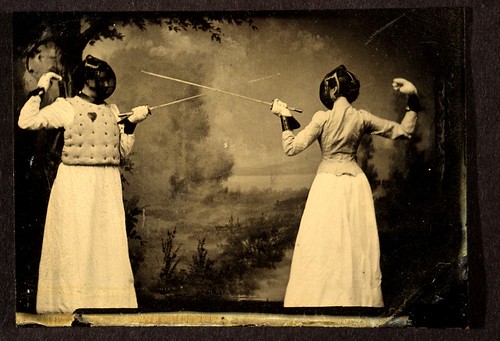
Two women fencing by George Eastman House.

Two Women Fencing, Unidentified Artist, ca. 1885. 
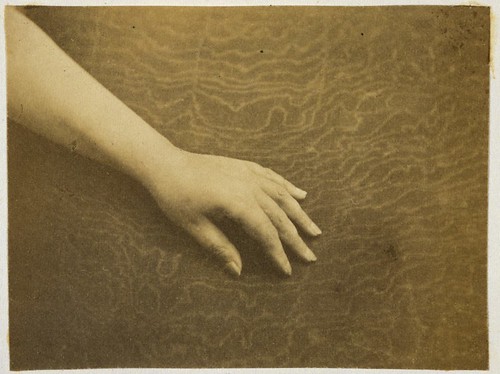
Le main de Madame Hugo by George Eastman House.

La Main de Madame Hugo, by Auguste Vacquerie, 1853-4. 

These images are from the collection at the George Eastman House International Museum of Photography and Film in Rochester, New York.  This collection is in the public domain—not copyrighted.

Being a lover of art and women’s history, I had to share some with you.  Although the online collection spans years up to the mid-20th century, I picked out nineteenth century ones because, to me, it’s exciting to see photographic images of a time that far gone. 

I’ve done a little online detective work to learn about who the subjects and/or photographers represented here were.  That information is below in the large fonts.   

The photo above, taken by the French photographer Auguste Vacquerie, must be of the hand of that Mme. Hugo—wife of Victor.  Vacquerie was connected to the Hugo family through his brother’s marriage. 

The image below by the English photographer Henry Peach Robinson supposedly depicts Viola from Shakespeare’s Twelfth Night.  I found that out in a book about nineteenth century photographic theory and feminism, but…I was too tired really to understand what it said. 
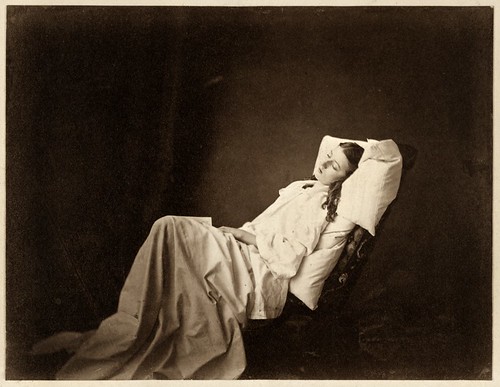
She Never Told Her Love by George Eastman House.

She Never Told Her Love, by Henry Peach Robinson, 1858.

The two photos below are by John Thomson, a Scottish pioneering photographer whose work among street people of London was a precursor to the field of photojournalism. 

Being the passionate thrifter and clothes recycler that I am (I still have not bought any new clothes since last February), I was really fascinated with this one of the old clothes shop.  I’ve never seen anything like it.
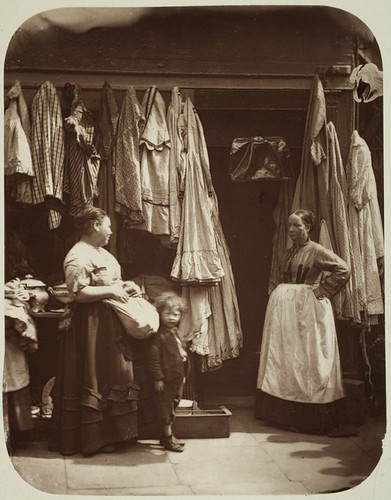
An Old Clothes' Shop, Seven Dials. by George Eastman House.

An Old Clothes Shop, Seven Dials, by John Thomson, 1876-7. 
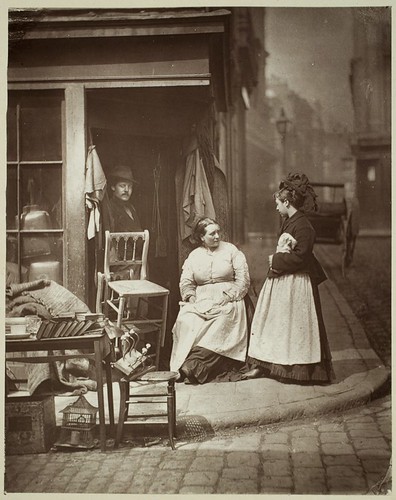
Old Furniture. by George Eastman House.

Old Furniture, John Thomson, 1877. 

The photo below is titled “Petipa.”  I’m quite certain the dancer is Mariia Surovshchikova-Petipa, who was prima ballerina to the St. Petersburg Imperial Theatres in the late 1800s.  She was married to the choreographer Marius Pepita. 

Interesting that in the fifth and sixth shots her arms are kind of at half-mast; not a true fifth position, and an unusual way to hold her hands (by today’s ballet standards). 
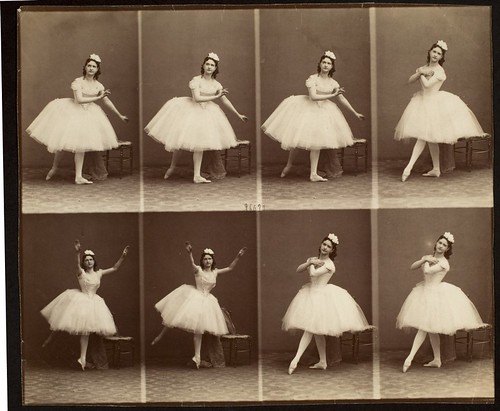
Petipa by George Eastman House.

Petipa, Andre-Adolphe-Eugene Disderi, 1862. 

The image below is by Julia Margaret Cameron, a British photographer from the Isle of Wight who found her art when she was 48 years old. 
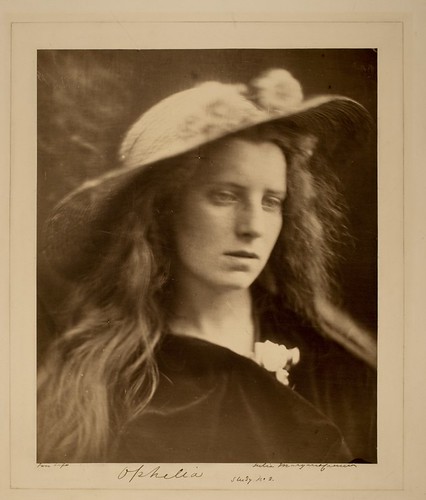
Ophelia Study No. 2 by George Eastman House.

Ophelia Study, Julia Margaret Cameron, 1867.
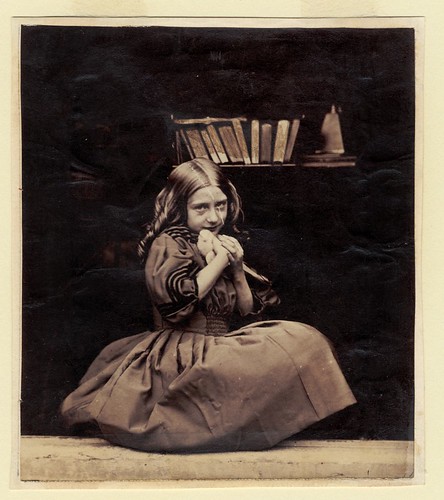
Girl with dove by George Eastman House.

Girl With Dove, Oscar Rejlander, 1860. 

The hand-tinted image below by early Japanese photographer Shin-E-Do looks like it could have been taken yesterday. 

Shin-E-Do was known for depictions of Japanese life during the Meiji period (the last half of the nineteenth century)—a time of modernization and increasing status in the world. 

I know little about how kimono and obi were traditionally worn, but I find it interesting that her obi is down around her hips, as in most of the images I’ve seen, it’s worn farther up the body.  Maybe that was a style of the period?  Or maybe her own personal style?  Or…?
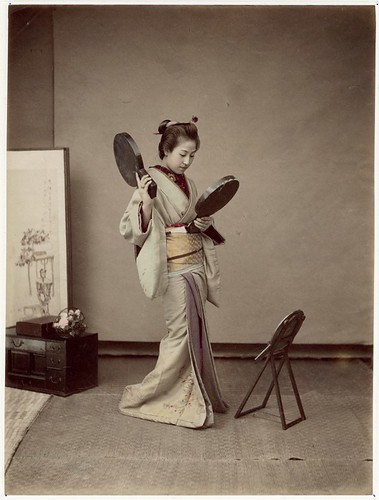
Japanese woman with mirrors by George Eastman House.

Japanese Woman With Mirrors, Shin-E-Do, 1890. 

Aren’t these photos wonderful? 

sallymandy